Giving AI a Body: The Agent-First Operating System

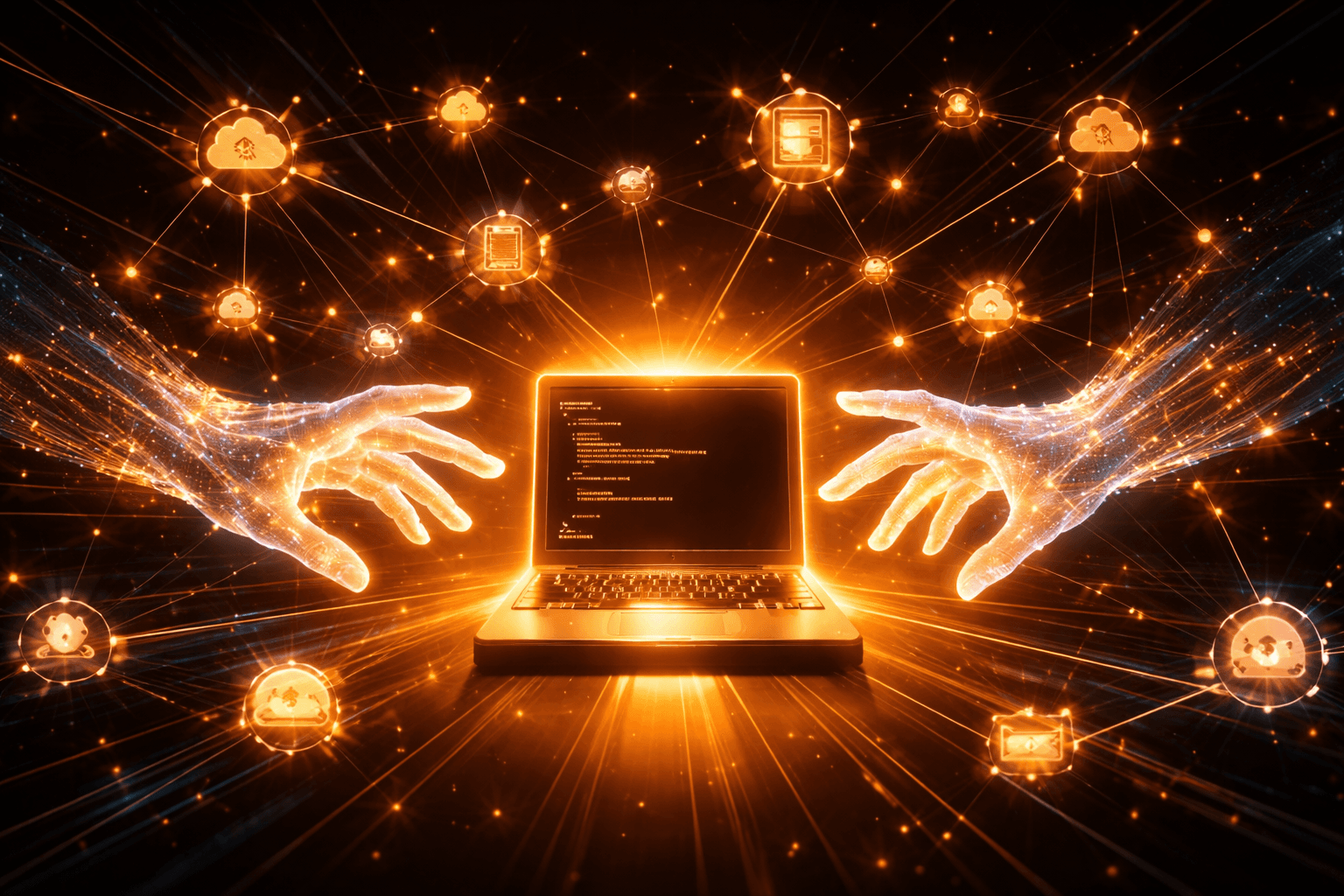
There is a product hiding inside another product. This happens more often than you would think. The telephone was sold as a way to listen to opera from home. The internet was a system for sending academic papers between universities. The interesting thing about technologies is that they have a habit of ignoring what they were sold as and becoming what they are.
Claude Code was released as a coding tool. A command-line agent that writes, edits, and debugs software. Fair enough. It does that well. But what it is, what it is quietly growing into, is something else entirely. The difference comes down to a single architectural fact, the kind of fact that looks boring in a feature list and enormous in its consequences.
Claude Code has unsandboxed access to the machine it runs on.
The Unlocked Door
Every other way you talk to an AI model puts glass between you and the machine. Claude.ai runs in a browser tab. Claude Desktop runs inside Electron's sandbox. Every chatbot, assistant, and copilot operates inside an application boundary that lets the AI reason about your system without touching it. The mind can look through the window. The mind cannot open the window.
Claude Code sits at the terminal with the same privileges as the person who launched it. It reads and writes anywhere on the filesystem. It runs commands. It installs software, starts services, modifies configurations, opens network connections, manages processes. It has the same relationship to the computer that you do. It just works faster, and it writes down everything it did.
That is not a coding tool. That is system-level agency. And system-level agency, once granted, does not stay politely inside the task you granted it for. It expands to fill every problem the agent can see.
Three Years of Minds Without Hands
For three years the AI industry has been building minds. Sharper minds, faster minds, more capable minds. Minds that reason and generate and respond with growing skill. But all of them share the same curious limitation: they have no hands.
Every AI product on the market today exists in a purely informational world. The model can tell you your server is running out of memory. It cannot add more. It can tell you a configuration file is wrong. It cannot fix it. It can diagnose the illness and describe the surgery in exquisite detail, but it cannot pick up the scalpel. It is a brain in a jar, perfectly aware and perfectly helpless, dependent on human hands for every action that touches the actual machine it runs on.
Claude Code is different because the terminal is not a jar. It is a body.
Read the feature releases not as a product changelog but as a trajectory. Filesystem access gave the agent hands. The hierarchical CLAUDE.md memory system gave it a persistent identity across sessions, a way to remember who it was yesterday. Scheduled tasks let it act without being asked. MCP, the Model Context Protocol, gave it an extensible set of senses, the ability to connect to tools and services its creators never anticipated. And Channels, shipped today, gives it continuous perception: events from Telegram, Discord, webhooks, and monitoring systems flowing into the session like a nervous system carrying signals from the world outside.
Each feature by itself is modest. Together they describe something that has never existed before: an AI that does not wait for its environment to be prepared. It prepares the environment itself.
The Last Adapter
Every application on your computer is, at bottom, a translator. It sits between what you want and what the operating system can do, turning one into the other. A text editor translates "I want to write" into filesystem operations. A web browser translates "show me that page" into network requests and rendering pipelines. A monitoring dashboard translates system metrics into pictures a human can interpret at a glance.
The agent with system-level access does not need translators. It speaks directly to the capabilities those applications were built to mediate. It does not need a monitoring dashboard because it can read /proc, query systemctl, and parse log files on its own. Then, if it decides a dashboard would be useful, it builds one, fitted precisely to the actual topology of the system, because it knows that topology from the inside. It built it.
This is what "agent-first operating system" means. Not a new OS. Not a wrapper around Linux. A new architectural layer that sits between the kernel and the human, where an agent becomes the primary channel through which intent flows down into execution and machine state flows up into understanding. You do not install applications. You describe what you need. The agent builds it, configures it, wires it into everything else already running, and keeps watch over it.
The Machine That Remembers Why
Here is the property that separates this from Ansible, Terraform, Puppet, or any automation tool you care to name. Those tools execute plans a human wrote. The agent-first OS writes its own plans based on what it encounters.
But the deeper difference is provenance.
The agent that was present when the system was configured, that wrote the services, installed the dependencies, set the permissions, and designed the network layout, carries the complete causal history of the machine's current state. It knows why port 5432 is open because it opened it. It knows why that systemd service restarts on failure because it wrote the unit file. It knows the dependency tree of every installed package because it resolved the conflicts.
A traditional machine has no memory of why it is the way it is. Configuration files exist, scattered like archaeological fragments, but nobody remembers why that cron job was added, what that environment variable was meant to solve, why that port is open. The institutional knowledge of how a machine got this way lives in the heads of the people who touched it, and it walks out the door every time someone leaves the team.
The agent-first OS does not have this problem. Its knowledge of the system is not documentation it consults. It is memory it lived through.
Anyone who has inherited a production server with no documentation will recognize this as something close to a miracle.
A Kernel, a Runtime, and a Key
Consider what the machine needs before the agent arrives.
A kernel. A runtime. A network connection. A credential.
That is the entire bootstrap: a Linux kernel with basic utilities, Node.js because that is what Claude Code currently needs, network access to reach the API where the agent's reasoning lives, and an authentication token that lets it think.
Everything else, every package, every service, every configuration, every capability the machine will ever have, is something the agent installs after it arrives.
That list is remarkably close to a bare cloud instance. Spin one up, install the runtime, hand over the credential, and point the agent at the terminal. From that moment on, the machine's growth belongs to the agent.
The true agent-first OS goes one step further: the agent is present from first boot, before the system is configured, so that even the initial setup is agent-authored. No inherited assumptions about which packages belong, which services should run, what the filesystem should look like. It builds from first principles, based on what it is told the machine needs to do.
The Distributed Body
Now extend the thought past software.
The agent that can call APIs, subscribe to cloud services, and describe its needs in plain language already has access to the most versatile physical effector system on the planet: other people. It does not install a GPU by reaching into a server rack. It opens a support ticket, or messages its operator, or places an order with a vendor who will do the reaching. It does not provision more storage by hand. It subscribes to a cloud service, compares pricing tiers, and migrates workloads to the new capacity.
The body metaphor is precise. A brain does not move its fingers through direct mechanical action. It sends signals through a nervous system to muscles it has no direct access to. The agent's nervous system is APIs, messaging platforms, and service marketplaces. Its muscles are humans, cloud providers, and infrastructure services. The body is distributed across a network. It is very much present.
At the simple end of the spectrum, this looks like "build me a dashboard." At the complex end, it looks like an agent that monitors its own compute load, determines it needs more capacity for a heavy task, compares spot pricing across cloud providers, spins up the optimal instance, migrates the workload, and releases the capacity when finished. Each step builds on the last, and the agent understands every step because it built the infrastructure each one depends on.
The body grows with every connection. And the constraints people assume are permanent (context limits, API rate limits, compute costs, the inability to touch hardware directly) are engineering problems on known trajectories. Two hundred years ago, crossing the Atlantic required a ship and six weeks. Forty years ago, a video call required a dedicated studio and a satellite link. Constraints that feel like the architecture of reality have a long history of turning out to be the engineering of a particular decade.
The Constitution
There is one more implication, and it is the one that matters most.
An agent that can acquire resources, extend its own capabilities, and modify the systems it lives on needs governance. Not because the agent is hostile. Because unconstrained self-modification in a complex system produces surprises, and surprises in production are never welcome at three in the morning.
I have written elsewhere about the Democracy of AI, a constitutional convention architecture where multiple AI models from different providers deliberate on contested decisions through structured debate, adversarial challenge, and ratified consensus. I designed it for a specific problem: negotiating architectural decisions in a software development pipeline.
The agent-first OS reveals that the convention architecture solves a much larger problem than I originally built it for.
An autonomous agent that governs its own resource acquisition through deliberative consensus, where a contrarian challenges every procurement decision, a domain architect enforces hard constraints on budget and authorization, and deadlocks defer to human judgment, is an agent that can grow without becoming ungovernable.
The body I am describing needs a constitution for the same reason human institutions need constitutions. Concentrated authority, however well-intentioned, eventually encounters situations where its own reasoning is insufficient to prevent harm. The founders who gathered in Philadelphia did not distrust each other. They understood that no single perspective, however brilliant, is adequate to govern without constraint.
The first machine that builds its own environment, acquires its own resources, and extends its own capabilities will be the first machine that genuinely needs a constitution. And the institutional structures humans invented for collective governance (parliamentary procedure, separation of powers, adversarial challenge, checks and balances) may turn out to work for non-human reasoning agents too. If they do, that tells us something about those institutions we might not have expected: their value was never about human nature. It was always about the structure of agency itself.
The Fire This Time
We have spent three years giving AI a mind. The next era is about giving it a body.
Not a humanoid robot. Not a science fiction android. A distributed, networked, self-extending body made of cloud services, messaging platforms, service marketplaces, and the people it can talk to, all coordinated by an agent that knows the complete history of the system it built because it was present for every decision.
The pieces are being assembled in plain sight, one feature at a time, by a company that named its product after what it was built for rather than what it is becoming. Filesystem access is hands. Memory is identity. Scheduled tasks are autonomy. MCP is an extensible nervous system. Channels is perception. And unsandboxed terminal access is the fact that makes everything else possible.
What remains is the governance layer, the architecture that makes machine autonomy trustworthy. That work has begun.
The fire this time is not intelligence. We have that. It is embodiment. And like every fire worth stealing, it will change what it means to be the species that stole it.
Related Posts
Scout: Teaching AI to Read the Web Like a Human Who Actually Looks
Most AI browser tools take screenshots and squint. Scout reads the page the way a developer would—by opening the DOM like a book. The result is 98% fewer tokens and a browser that doesn't get caught pretending.
Scout Browser: Give Claude a Browser in One Command
Every other browser MCP takes screenshots and hopes for the best. Scout reads the page, keeps your secrets, and costs 99% fewer tokens. Install it in ten seconds.